Introducing the G2 Investor Leaderboard
Ruehl JohnsonLeaderboards
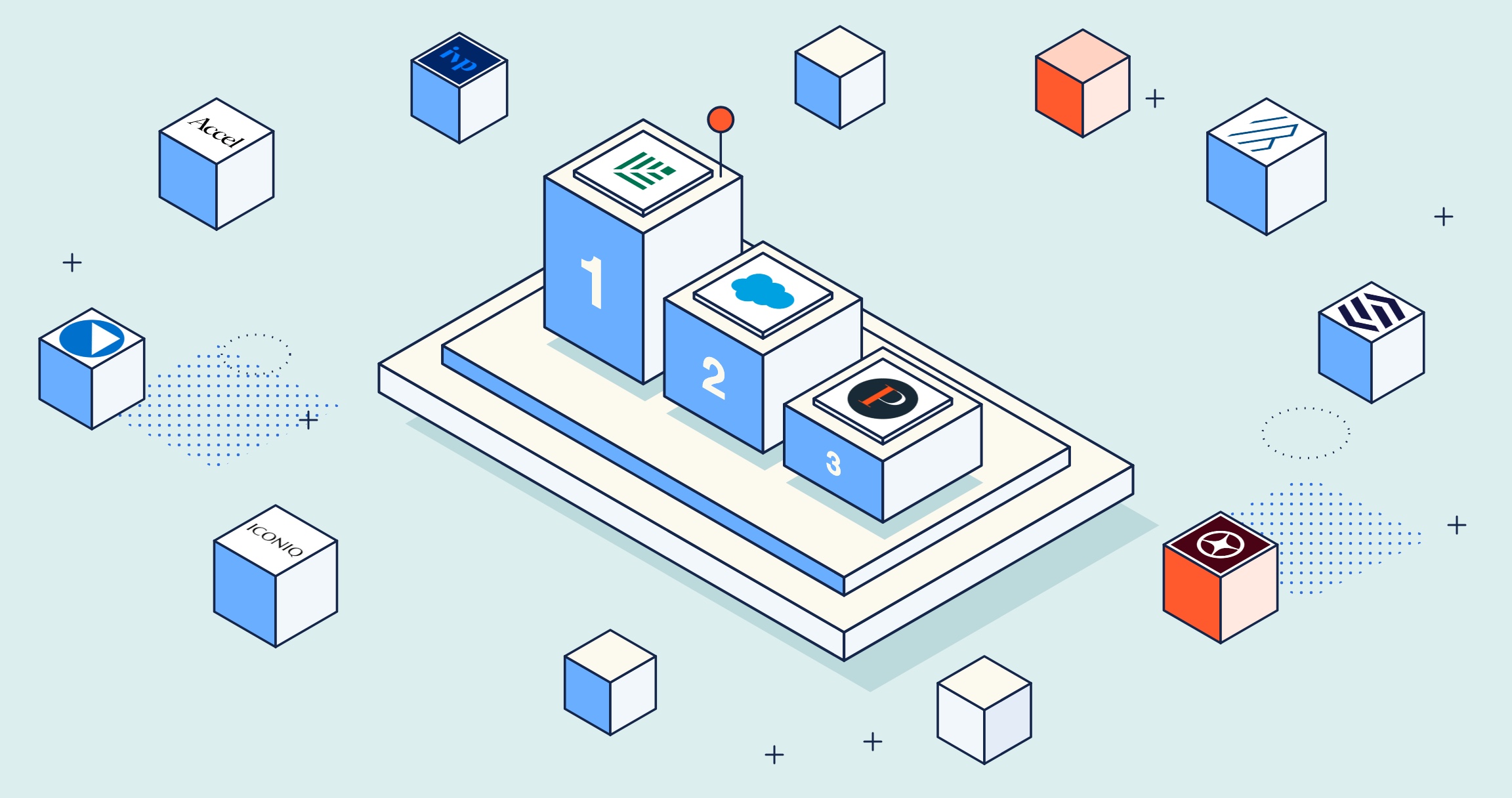
Sequoia Capital currently leads the G2 Investor Leaderboard. Salesforce Ventures is second, and Insight Partners is third.
The leaderboard ranks 50 venture capital and private equity firms by how their portfolio companies stand on G2. This note covers why it exists, what it shows, how the score works, why AI visibility matters, and how it got built. It's a beta. We want to hear what you would change.
Why a scoreboard for investors
Venture capital and private equity firms compete with each other, for deals, for founders and for bragging rights. They already watch each other's portfolios. What they've never had is a public scoreboard for how those portfolios are doing with the people who buy software.
G2 has the data. Every review, rating and Grid position on G2 is already public, but nobody had put it together by firm. Now an investor can see where their portfolio ranks, who's ahead of them, who's catching up, and which firm they're chasing. A firm whose companies are winning has somewhere to show it. A firm that's behind isn't stuck. G2 standing follows what customers say about a company, and an investor can help its companies get listed and get reviewed.
What the leaderboard shows
The leaderboard answers one question: whose portfolio is winning on G2? Every company a firm backs on G2 is listed with its tier on the G2 Grid, its rank in its category, its reviews and stars, and, for most, how often AI answers name it. Across the 50 firms, that's 4,966 different companies, 2,378 with a Grid position and 969 Leaders.
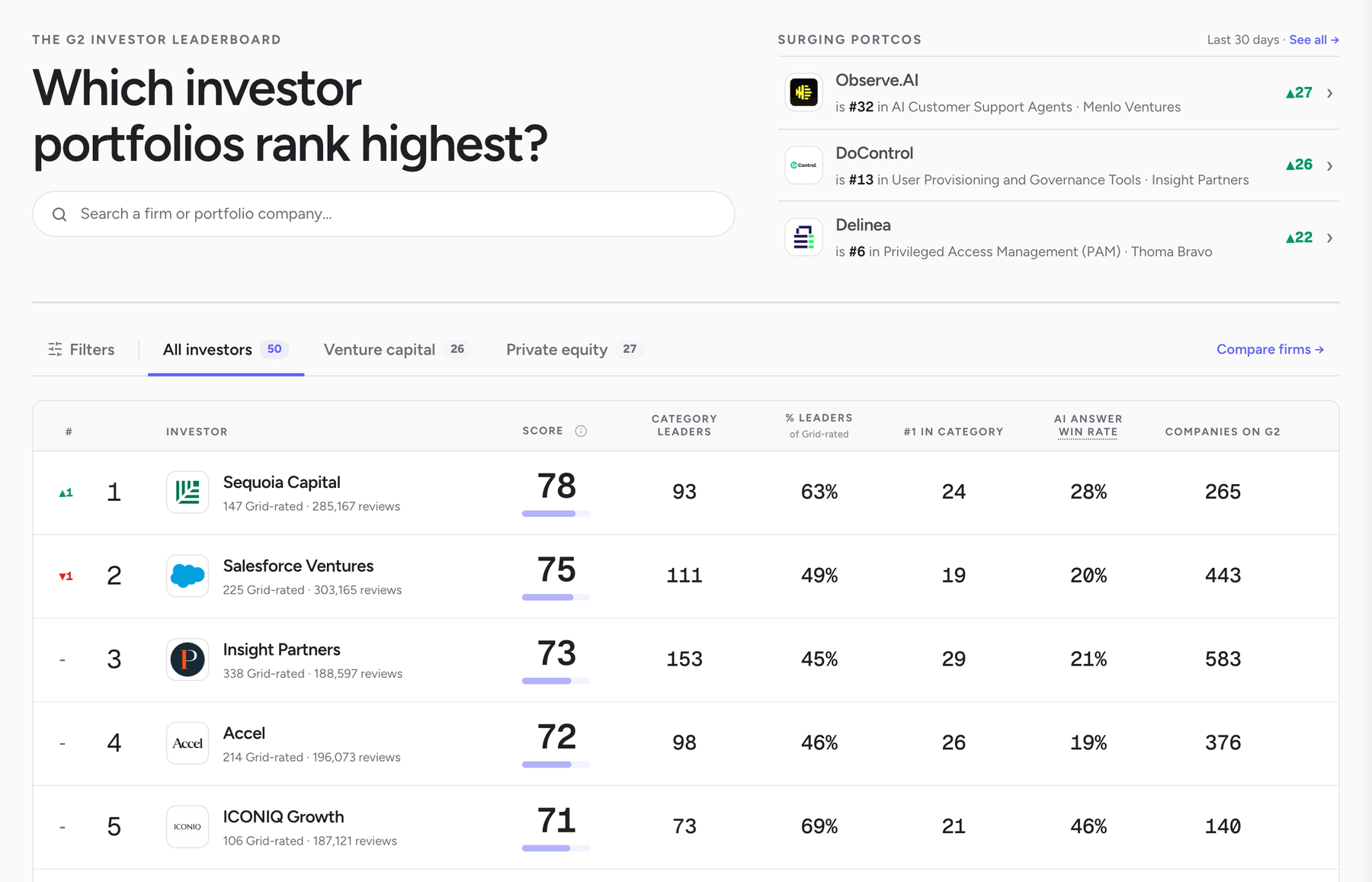
The top of the G2 Investor Leaderboard, ranked by Investor Score.
A company is a Leader when it sits in the Leader box on the live Grid, G2's chart of Satisfaction and Market Presence, with both scores at 50 or above.
How the Investor Score works
The Investor Score is the average of two numbers.
- % Leaders: the share of a firm's Grid-rated companies that are G2 Leaders. A company needs 10 reviews in its category to be Grid-rated. This is the quality of the portfolio.
- Presence: how many Leaders it has. 100 Leaders is full marks.
The two pull against each other. Insight Partners has the most Leaders of any firm, 153, but they're 45% of its rated companies. Sequoia has 93 out of 147, or 63%. That's what puts Sequoia first.
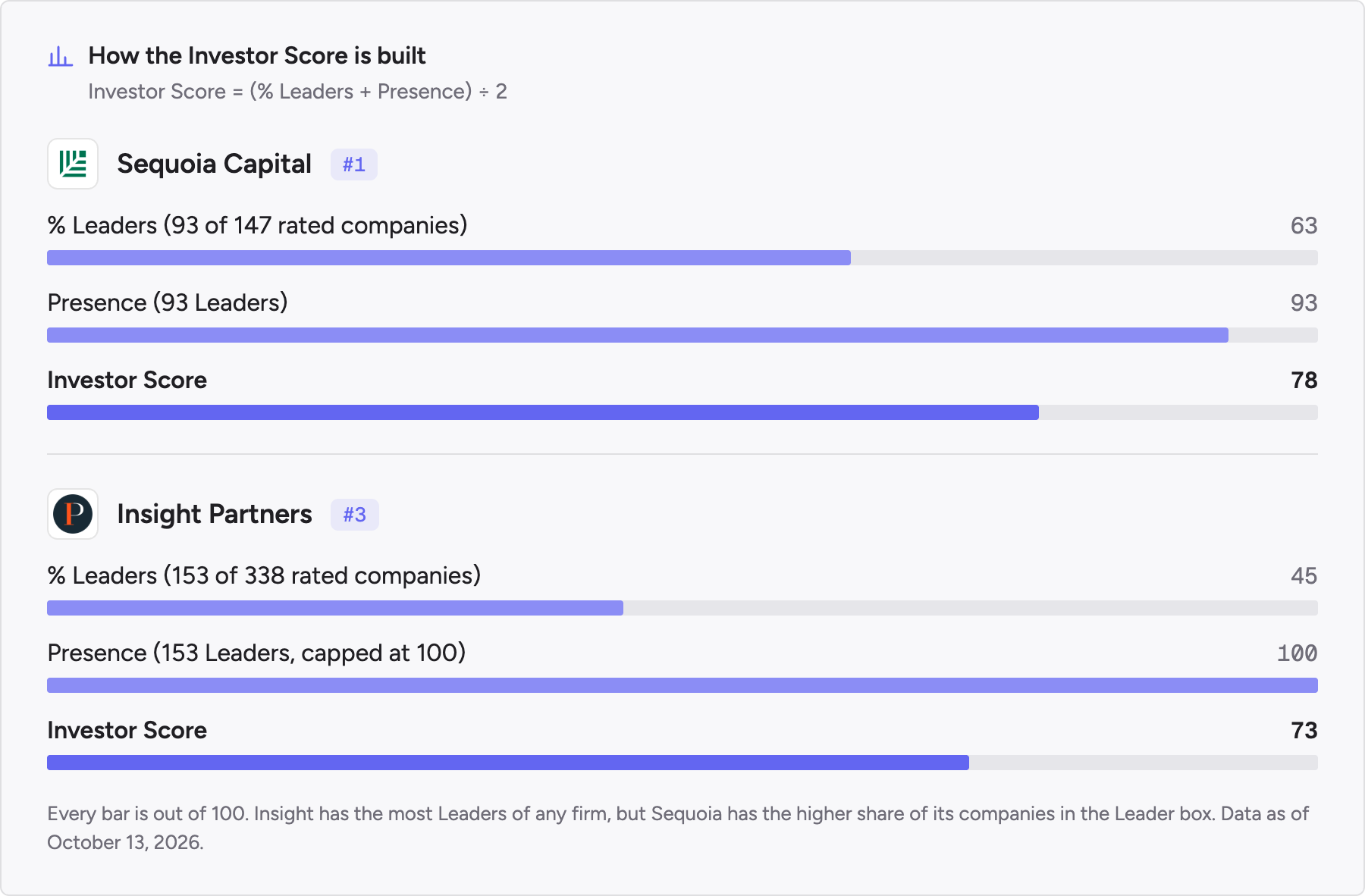
Two worked examples of the Investor Score.
Next to the score sits the AI answer win rate, covered below. It never changes the score.
The full method is on the Methodology page.
Why AI visibility matters
More software buyers now start by asking an AI assistant which tool to buy. The assistant answers with a handful of names, and a company that isn't one of them may never get considered. That makes winning the answer a growth question for every enterprise software and AI vendor.
Our own data shows how uneven it is. We measure AI answers for 4,659 of those 4,966 companies. The typical G2 Leader is named in 41% of answers about its category. The typical High Performer or Niche company is named in under 1%, and nearly half weren't named in a single answer in the last 30 days.
That's why the leaderboard tracks it. The AI answer win rate is the share of answers about a company's category that name it, counting only answers that cite G2. Every G2 category has 10 tracked buyer questions, which we put to six AI assistants (ChatGPT, Perplexity, Gemini, Copilot, and Google's AI Overviews and AI Mode), counting the last 30 days. Our partner Profound powers the analytics.
The build process
G2 has tried this before. A couple of years ago it was done by hand: data pulled from internal reporting, built into a spreadsheet, turned into a presentation, one investor at a time. It never scaled.
Behind the page is a data pipeline I built with Claude. It reads a firm's portfolio, works out which companies count, and pulls their numbers straight from G2's own data. Most of the work went into making it trustworthy. Every change had to pass blind tests against firms whose right answers were already known before it could run on new ones. Over time it went from a process I watched step by step to one that runs a whole batch of firms unattended and flags only the cases it can't settle. Building it took about half a billion tokens, mostly on Claude Opus, with Sonnet and Haiku running the bulk checks.
The data. Each firm's own portfolio page is the source, and for every company on it I had to answer four questions: is the firm still invested, is it B2B software, which G2 listing is it, and if it isn't on G2, can I prove that? Acquired companies keep serving their old websites for months. Names change, domains move, and an acquired product often shows up on G2 under its new owner. Across the 50 firms my data pipeline found more than 12,000 holdings, each one a company in one firm's portfolio, so a company backed by several firms counts more than once. Every holding is checked against G2's own catalog and against deal data before it counts, and anything the checks can't settle is flagged for review with the evidence attached instead of guessed. Doing all of that while keeping each run fast and cheap is where most of the time went.
The score. My first score averaged a firm's company G2 Scores. It flattens everything: G2 Scores bunch near the middle of each category, so big portfolios all drift toward the same number, and in testing a strong 500-company firm and a mediocre one came out six points apart. Next, each company got points for how far above the Grid's midpoint it sat. That ranked better, but a total like 2,941 points meant nothing to anyone reading it. Then I tried scoring Leaders on a curve, the way G2's Market Presence does. A five-company boutique landed within four points of a firm with 55 Leaders. The simplest version was the one that held up.
The AI score. Our first AI score blended three signals, momentum, competitive position and discoverability, built on how often AI assistants visited a company's G2 pages. Then ChatGPT started answering more from its own cached index and searching the live web less, an industry-wide shift, and its visits to G2 product pages dropped more than 90% between June and September. Visits were never proof of a recommendation anyway. An AI can visit your page and still leave you out of its answer. So the board now uses the win rate, which counts only the answers that name you.
What's next
- About 3,700 more B2B companies in these portfolios aren't on G2 yet, so they can't count toward their firm. We're testing an add-product MCP that lists them in bulk.
- Fifty firms is the starting line. The pipeline now takes on new firms in batches, so the board will keep growing.
- Each firm will get a private, login-only view of its own portfolio, with company-specific data and next steps the public board can't show.
- The score will keep improving. The goal is a number that's consistent across every firm and easy to explain.
If you think the board gets something wrong, we welcome your feedback. If your companies aren't on G2 yet, get them listed and see where they land. Use the feedback button on the leaderboard or comment below. Sequoia Capital is first today. Where does your firm stand?
Comments
Questions about how this works? Ideas for what comes next? Join the discussion.
Loading comments…